Here is an excerpt form a 1997 Stout Foundation Report:
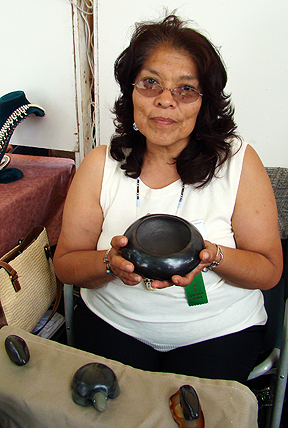
Kathy Sanchez, an Indigenous American potter from the
historic San Ildefonso Pueblo, spent a week on the
University of Wisconsin-Stout campus Sept. 16-20 during
which she demonstrated her 1500-year-old craft.
Sponsored by a grant from the Stout University
Foundation Inc., Sanchez was the guest of the department
of art and design.
Sanchez carries on the tradition of her late great-
grandmother, Maria Martinez, a world-famous potter.
Known as blackware, her pottery is carried on through
the extended family of San Ildefonso Pueblo potters.
This traditional ware is now sought after and prized
throughout the world.
Though often termed “primitive,” the process she
uses is really quite complex. The reddish earthenware
pots are shaped by hand and, when dry, are coated with
an earthenware slip. Before this “veneer” can completely
dry, the surface is then polished with a smooth river
stone. The stones themselves are prized tools, often
passed down through generations of potters. After
polishing, the pot is decorated with images and symbols
of the Pueblo’s beliefs and heritage. Traditionally, a
yucca plant “brush” with a chewed tip is used to decorate
the earthenware.
After drying, the pottery is placed on an open grate
over cedar kindling and the pieces covered with thin
metal such as flattened tin cans, old sheet metal and even
surplus army food trays. Around this mound, either slab
wood or dried dung cakes are stacked and, after all is
ready, the kindling is ignited and the entire mound
begins to burn.
When the potter determines that the firing has
progressed far enough, the flaming mound is quickly
smothered with pulverized cow or horse manure. Then
the “kiln” is covered with ashes from previous firings
and allowed to smoke or carbonize for 45 minutes to an
hour.
When the pots are removed, the reddish polished
areas have turned into a rich shiny black and the decorated
areas a mat black, clearly in contrast to the surface of the
pot. The effect is totally unlike any other unglazed
pottery one might see. As Pueblo potters have gained
more economic independence, their work continues to
mature and develop.
Sanchez has received numerous awards, such as the
Smithsonian Native American Scholar Fellowship to
research archival museum artifacts and a National
Endowment for the Arts grant to produce a video, titled
“Pi’ee Quiyo Spirit Woman of Clay,” chronicling six
generations of Martinez blackware traditional pottery.
She has been instrumental in helping to establish the
Tewa Women United, a group comprised of women
from eight pueblos in the Santa Fe area and dedicated to
focusing “...self-esteem building, values clarification,
communication skills, assertiveness training, adjustment
to life transitions, alcohol education, issues of co-
dependency and goal setting.” Her most recent
involvement in this issue was her attendance at the
International Womens’ Conference held last year in
Beijing.

 Here is an excerpt form a 1997 Stout Foundation Report: